I wanted to organise our household spending and look back at what we bought and how much we spent.
That meant checking the receipts. I had kept them for that purpose—until the pile grew beyond what I could manage.
More than 2,000 receipts. An impressive collection of records. If only they were organised. (Laughs.)
Then I had an opportunity to visit an accountant I knew. They happened to be doing their accounts, scanning receipts and giving the resulting images filenames.
That was it!
I asked how they organised everything.
There was one difference: I was a systems engineer, not an accountant. I was comfortable developing systems. Scanning receipts, however, felt tedious. (Laughs.)
So I bought a scanner a little lower in the range than the one they used.
A new portable scanner. It could read receipts one after another. For someone who dislikes tedious work as much as I do, it felt like a promising ally.
I enthusiastically scanned the first 100 receipts.
Then I cheerfully checked the images… and found only 31.
Where had the rest gone?
A receipt had jammed partway through. I had assumed that removing it and restarting would simply let the scanning continue.
I was thinking of printing a document: clear a paper jam, then resume printing from where it stopped. I expected something similar from the scanner.
So I ran a small test.
The systems engineer in me had sprung into action. (Laughs.)
What I observed in that test was that only the images from the receipt I rescanned after clearing the jam onward remained.
Suppose the jam occurred at receipt 70 in a batch of 100, and I restarted from that receipt. I expected the first 69 images plus the next 31: all 100.
But with the way I was using it, what I could confirm was only the latter 31.
I had treated “the paper went through” as meaning “the images are all there.”
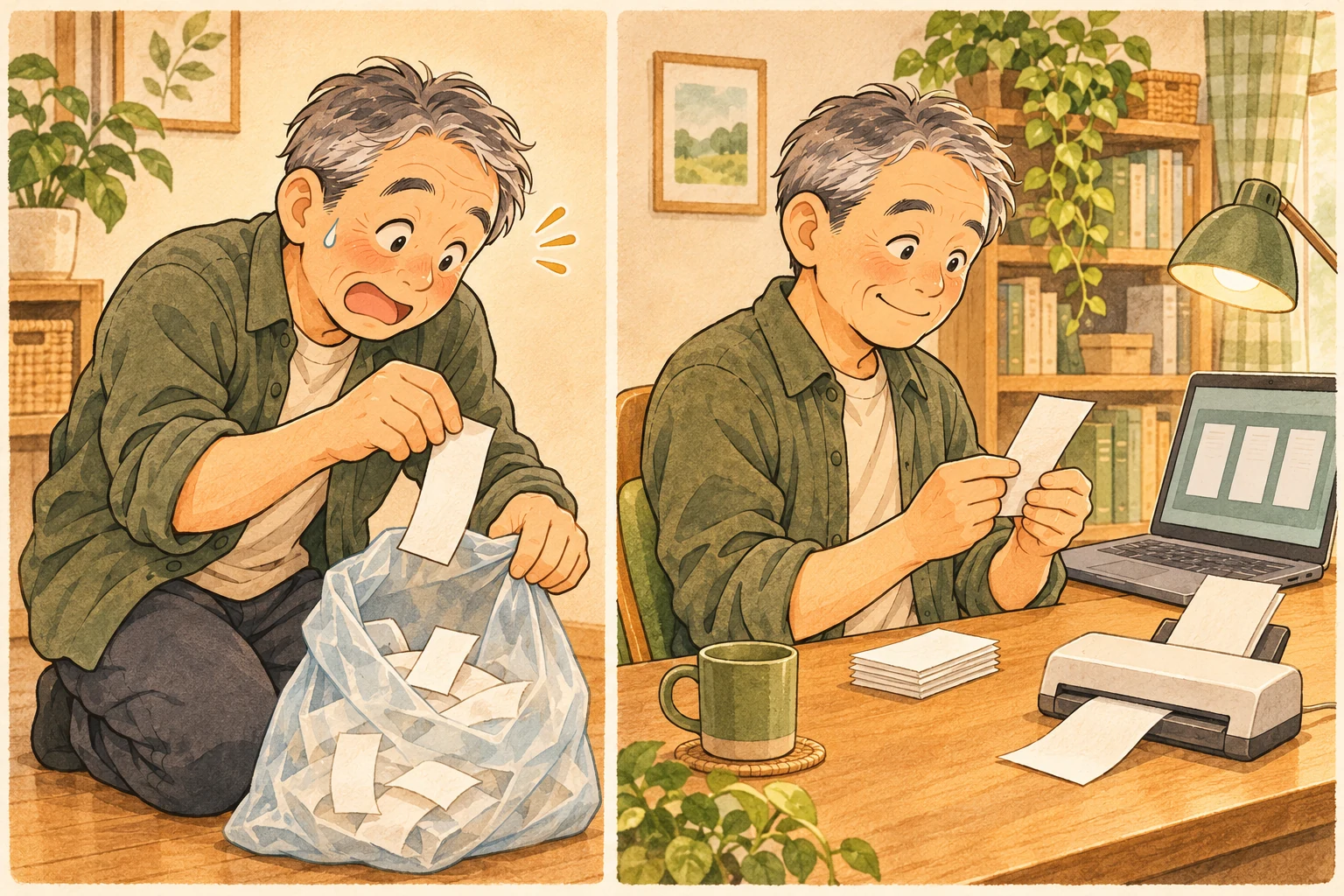
And on that assumption, I had been putting the receipts into a rubbish bag as I went.
Apparently, I was quicker at tidying up than at checking the scans. (Laughs.)
It was good to discover this behaviour within the first 100. Imagine finding out only after working through more than 2,000…
Unfortunately, the bag in front of me was already chaos.
Find the 69 unscanned receipts among those 100. Easy to say. Sorting them out looked quite another matter.
Before I could review our spending, I had acquired a job reviewing the contents of a bag.
I had put too much faith in my new gadget.
So I consulted my trusted adviser, Kimiko-chan—the name I gave ChatGPT.
The suggestion was to scan ten receipts, check that there were images for all ten, and only then move on to the next ten.
“More haste, less speed.”
Fair point. Still, here was advice to give someone who dislikes tedious work another tedious task: checking. (Laughs.)
Then again, it was much better than searching through that bag.
I decided to rescan in batches of ten, checking the image count as I went.
Precisely because I wanted to leave the work to a tool, I needed to check its output in small batches.
For an older fellow who had skipped a tedious step and ended up with an even more tedious job, it was advice that hit home. (Laughs.)